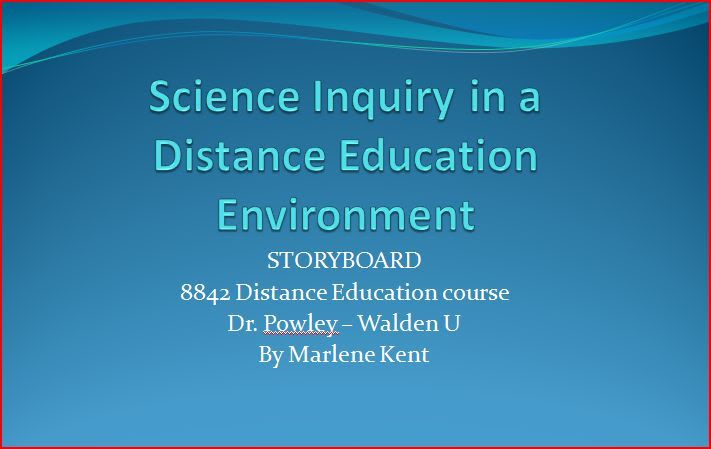
Slide 1)
http://i682.photobucket.com/albums/vv184/MKent48/Slide1A.jpg
Title: Science Inquiry in a Distance Education Environment:
STORYBOARD
8842 Distance Education course
Dr. Powley – Walden U
By Marlene Kent
Slide 2) http://i682.photobucket.com/albums/vv184/MKent48/Slide2A.jpg
Title: Traditional f2f recipe Biology labs
Video clip reenactment of students bored, off task, off topic, uninterested, unmotivated in a f2f teacher-directed lab situation on “The Effect of Temperature on Goldfish Respiration Homeostasis”.
Slide 3) http://i682.photobucket.com/albums/vv184/MKent48/Slide3A.jpg
Title: Inquiry Biology Homeostasis lab
Video clip of students engaged in asking questions, working in teams and designing their own inquiry lab on testing the effect of temperature on homeostasis in Goldfish respiration and behavior.
Slide 4) http://i682.photobucket.com/albums/vv184/MKent48/Slide4A.jpg
Title: Brain Neuroscience – Dopamine opens the doors
Recipe Labs: stress, boredom, confusion, low motivation, and anxiety can interfere with learning. Sensory input is blocked from entering the cortical areas of memory storage that lie beyond the amygdala
Inquiry Labs: Frontal lobe involvement
Neuronal circuits going from the limbic system (emotional center) into the frontal lobe and other parts of the brain are rich in dopamine receptors that are activated by this dopamine release (Nader et al. 2002).
Many of the strategies teachers use to engage students in learning have been demonstrated to activate this dopamine release (Wunderlich et al. 2005)
Slide 5) http://i682.photobucket.com/albums/vv184/MKent48/Slide5A.jpg
Title: Brain Neuroscience –
What turns on dopamine?
"With students' brains turned to the ideal state of activation, the speed and efficiency of information flowing through the filter to the learning centers of the brain is optimal.“ Willis, J (2007)
motivation ,
student-centered,
choices,
inquiry-based learning activities
Slide 6) http://i682.photobucket.com/albums/vv184/MKent48/Slide6A.jpg
Title: Mind Map of the Workshop
Main Topics
What is Inquiry Science & why?
Brain research?
How construct DE environment for science inquiry
Multimedia tools
Synchronous tools
Asynchronous tools
Team responsibilities
Assessments in a DE environment
Slide 7) http://i682.photobucket.com/albums/vv184/MKent48/Slide7A.jpg
Title: INQUIRY SCIENCE From f2f to DE
List of media tools for collaboration:
Asynchronous:
Wiki
Blogs
Forums
Videos – Hippocampus, Gizmos
Virtual Manipulatives - Gizmos
Synchronous:
Skype
Video conference call/Breeze
Video clip showing screen shots or video clips of:
blogs,
wikis,
skype,
virtual labs (Gizmos) on Human Homeostasis,
AP Bio video clips from Hippocampus,
Tutorials
Slide 8) http://i682.photobucket.com/albums/vv184/MKent48/Slide8A.jpg
Title: DE Assessment Strategies
Peer evaluation
Instructor Rubrics
Instructor evaluation on participation
Instructor evaluation on individual growth (improvement)
Student self-reflections
Student self-evaluation
Slide 9)http://i682.photobucket.com/albums/vv184/MKent48/Slide9A.jpg
Title: Team Developed Rubrics
Team Norms
Team Charter development and agreement
List of assignments and individual responsibilities
Time line for time management
Monitor of team process
Pre-teach activities: ExD tutorial, Homeostasis tutorial
Role-play activity with virtual lab manipulative
Individual labs with pre-agreed on procedures, collect data, share & analyze with team
Team reflection
Self-reflections
Slide 10) http://i682.photobucket.com/albums/vv184/MKent48/Slide10A.jpg
References:
Facione, P.A. (1990). The California critical thinking skills test: college level technical report #1 – experimental validation and content validity. Santa Clara Univ, CA: The CA Academic Press, pp.1-14. ERIC Document ED 327-549.
Hurst, D. & Thomas, J. (2010). Developing team skills and accomplishing team projects online. In T. Anderson (Ed.), The theory and practice of online learning (pp441-472). Edmonton, AB: AU Press, Athabasca University.
Siemens, G. (2008). Assessment of Collaborative Learning. (Vodcast). Principles of Distance Education DVD produced by Laureate Education, Inc. Baltimore.
Siemens, G. (2008). Learning Communities. (Vodcast). Principles of Distance Education DVD produced by Laureate Education, Inc. Baltimore.
Smith, L. M., (2006). Effective science tools supporting best practice methodologies in distance education. Greenwich: Distance Learning (3) 4, pp. 47-57. Retrieved from http:/proquest.umi.com.ezp.waldenulibrary.org/pqdweb?index=3&s…on September 19, 2010.
Willis, J. (2007). Preserve the child in every learner. Kappa Delta Pi Record (44)1, pp. 33-37. Retrieved from http://www.inspiringteachers.com/classroom_resources/articles/curriculum_and_instruction/preserve_the_child.html
Showing posts with label DE. Show all posts
Showing posts with label DE. Show all posts
Sunday, October 10, 2010


Wednesday, September 15, 2010
What are the future trends for ID (instructional design) and DE (distance education) in the K-12 world?
What is the e-learning and instructional design (ID) research gap in K-12?
What are the future trends for ID and distance education (DE) in the K-12 world?
What does K-12 DE look like now?
In the educational world of K-12, DE is not growing as exponentially as higher ed, but we re seeing a steady growth, especially at our own southern California charter school where we are challenged with thousands of K-12 students that are home schooled.
We are also starting to see the emergence of free AP and Honors courses developed with short animations and videos for each concept (hippocampus http://www.hippocampus.org/) and other sites (http://www.khanacademy.org/), Alex, UC Regents. Some are not courses, but are great video resources for individual concepts.
Our charter school is currently using Moodle as a vehicle for out teachers to develop curriculum for academy (hybrid of f2f and home) and full time home school students. These are basically a series of assignments that correspond to textbook and other resources. It is not a flowing, learner-centered ID and has very little technological activities with the exception of links videos and online tutorials. It really is more of an attempt to copy classroom activities or replace them with boring worksheets if classroom activities are not possible for the home school student.
This semester, we have hired a consulting firm (e-Concordia) to help develop two courses with more multimedia infused (at a very high cost).
What are the biggest concerns or fears for what DE could be?
Some of the concerns expressed in the Huett, et al (2008) article are the mixed student populations which may consist of students that are least likely to succeed in the autonomous DE environment. The fear is that DE will become a dumping ground for credit recovery and
dropout students from traditional schools. As a result, the ID opportunities may be seriously underutilized.
This mixed population of students may face several outside distractions in their life styles – travel, social commitments, looking for enrichment, employed, rural, hospitalized, homebound, incarcerated, and be more of a challenge to reach through DE.
The choice between synchronous and asynchronous is a significant consideration with the K-12 population and asynchronous may not be a viable option for most because of little personal interaction with students and teacher. There are several issues of supervision and accountability especially with the younger and/or more immature students.
There is definitely a gap in the research-based effectiveness of online DE and ID at the K-12 grades. Another concern is the lack of trained professionals in DE and ID and that the courses may be developed to look like an f2f class, which would be counterproductive (Simonson, 2000).
According to Simonson’s equivalency theory, DE needs to provide “different but equivalent learning experiences for each learner.” (pg 29).
What should be the future trends in DE and ID?
ID should play a key role in building a research base to make decisions on ID for K-12.
The key is that the ID must serve the needs of students and the ID must ensure that the environment where the course is delivered is supportive for student-centered courses.
We may need to reorganization and hire professionals to develop DE curricula to meet these needs and to determine how we engage learners. Nationalize curricula like the AP courses are starting to emerge. We must honor that DE is not another quick fix educational program and we must focus on the needs of the learner.
In conclusion, since there is such a gap in the research and when comparing DE to f2f, what research we have is not showing significant differences, we need to build a research base for e-learning and ID.
References:
Huett, J., Moller, L., Foshey, W., Coleman, C. (2008). The Evolution of distance education:
Implications for instructional design and the potential of the web (Part 3: K-12). TechTrends
(52)5, pp 63-67.
Simonson, M. (2000). Making decisions: The use of electronic technology in online classrooms.
New Directions for Teaching and Learning, (Winter), 84, pp. 29-34.
Tags:
DE, ID, K-12 DE future trends, equivalency theory.
What are the future trends for ID and distance education (DE) in the K-12 world?
What does K-12 DE look like now?
In the educational world of K-12, DE is not growing as exponentially as higher ed, but we re seeing a steady growth, especially at our own southern California charter school where we are challenged with thousands of K-12 students that are home schooled.
We are also starting to see the emergence of free AP and Honors courses developed with short animations and videos for each concept (hippocampus http://www.hippocampus.org/) and other sites (http://www.khanacademy.org/), Alex, UC Regents. Some are not courses, but are great video resources for individual concepts.
Our charter school is currently using Moodle as a vehicle for out teachers to develop curriculum for academy (hybrid of f2f and home) and full time home school students. These are basically a series of assignments that correspond to textbook and other resources. It is not a flowing, learner-centered ID and has very little technological activities with the exception of links videos and online tutorials. It really is more of an attempt to copy classroom activities or replace them with boring worksheets if classroom activities are not possible for the home school student.
This semester, we have hired a consulting firm (e-Concordia) to help develop two courses with more multimedia infused (at a very high cost).
What are the biggest concerns or fears for what DE could be?
Some of the concerns expressed in the Huett, et al (2008) article are the mixed student populations which may consist of students that are least likely to succeed in the autonomous DE environment. The fear is that DE will become a dumping ground for credit recovery and
dropout students from traditional schools. As a result, the ID opportunities may be seriously underutilized.
This mixed population of students may face several outside distractions in their life styles – travel, social commitments, looking for enrichment, employed, rural, hospitalized, homebound, incarcerated, and be more of a challenge to reach through DE.
The choice between synchronous and asynchronous is a significant consideration with the K-12 population and asynchronous may not be a viable option for most because of little personal interaction with students and teacher. There are several issues of supervision and accountability especially with the younger and/or more immature students.
There is definitely a gap in the research-based effectiveness of online DE and ID at the K-12 grades. Another concern is the lack of trained professionals in DE and ID and that the courses may be developed to look like an f2f class, which would be counterproductive (Simonson, 2000).
According to Simonson’s equivalency theory, DE needs to provide “different but equivalent learning experiences for each learner.” (pg 29).
What should be the future trends in DE and ID?
ID should play a key role in building a research base to make decisions on ID for K-12.
The key is that the ID must serve the needs of students and the ID must ensure that the environment where the course is delivered is supportive for student-centered courses.
We may need to reorganization and hire professionals to develop DE curricula to meet these needs and to determine how we engage learners. Nationalize curricula like the AP courses are starting to emerge. We must honor that DE is not another quick fix educational program and we must focus on the needs of the learner.
In conclusion, since there is such a gap in the research and when comparing DE to f2f, what research we have is not showing significant differences, we need to build a research base for e-learning and ID.
References:
Huett, J., Moller, L., Foshey, W., Coleman, C. (2008). The Evolution of distance education:
Implications for instructional design and the potential of the web (Part 3: K-12). TechTrends
(52)5, pp 63-67.
Simonson, M. (2000). Making decisions: The use of electronic technology in online classrooms.
New Directions for Teaching and Learning, (Winter), 84, pp. 29-34.
Tags:
DE, ID, K-12 DE future trends, equivalency theory.
Subscribe to:
Posts (Atom)