Slide 1)
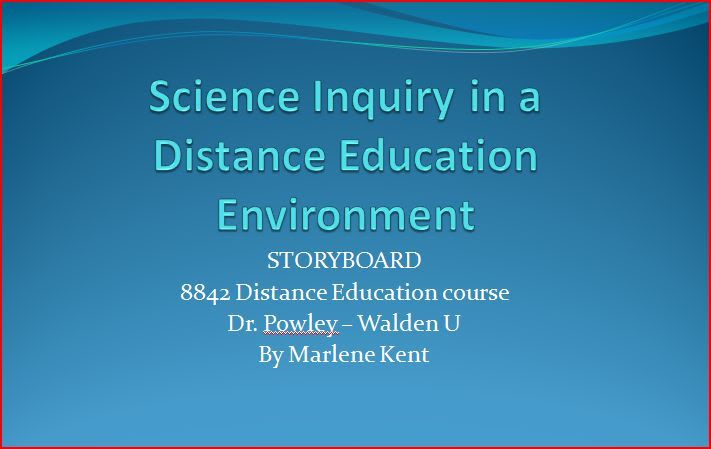
http://i682.photobucket.com/albums/vv184/MKent48/Slide1A.jpg
Title: Science Inquiry in a Distance Education Environment:
STORYBOARD
8842 Distance Education course
Dr. Powley – Walden U
By Marlene Kent
Slide 2) http://i682.photobucket.com/albums/vv184/MKent48/Slide2A.jpg
Title: Traditional f2f recipe Biology labs
Video clip reenactment of students bored, off task, off topic, uninterested, unmotivated in a f2f teacher-directed lab situation on “The Effect of Temperature on Goldfish Respiration Homeostasis”.
Slide 3) http://i682.photobucket.com/albums/vv184/MKent48/Slide3A.jpg
Title: Inquiry Biology Homeostasis lab
Video clip of students engaged in asking questions, working in teams and designing their own inquiry lab on testing the effect of temperature on homeostasis in Goldfish respiration and behavior.
Slide 4) http://i682.photobucket.com/albums/vv184/MKent48/Slide4A.jpg
Title: Brain Neuroscience – Dopamine opens the doors
Recipe Labs: stress, boredom, confusion, low motivation, and anxiety can interfere with learning. Sensory input is blocked from entering the cortical areas of memory storage that lie beyond the amygdala
Inquiry Labs: Frontal lobe involvement
Neuronal circuits going from the limbic system (emotional center) into the frontal lobe and other parts of the brain are rich in dopamine receptors that are activated by this dopamine release (Nader et al. 2002).
Many of the strategies teachers use to engage students in learning have been demonstrated to activate this dopamine release (Wunderlich et al. 2005)
Slide 5) http://i682.photobucket.com/albums/vv184/MKent48/Slide5A.jpg
Title: Brain Neuroscience –
What turns on dopamine?
"With students' brains turned to the ideal state of activation, the speed and efficiency of information flowing through the filter to the learning centers of the brain is optimal.“ Willis, J (2007)
motivation ,
student-centered,
choices,
inquiry-based learning activities
Slide 6) http://i682.photobucket.com/albums/vv184/MKent48/Slide6A.jpg
Title: Mind Map of the Workshop
Main Topics
What is Inquiry Science & why?
Brain research?
How construct DE environment for science inquiry
Multimedia tools
Synchronous tools
Asynchronous tools
Team responsibilities
Assessments in a DE environment
Slide 7) http://i682.photobucket.com/albums/vv184/MKent48/Slide7A.jpg
Title: INQUIRY SCIENCE From f2f to DE
List of media tools for collaboration:
Asynchronous:
Wiki
Blogs
Forums
Videos – Hippocampus, Gizmos
Virtual Manipulatives - Gizmos
Synchronous:
Skype
Video conference call/Breeze
Video clip showing screen shots or video clips of:
blogs,
wikis,
skype,
virtual labs (Gizmos) on Human Homeostasis,
AP Bio video clips from Hippocampus,
Tutorials
Slide 8) http://i682.photobucket.com/albums/vv184/MKent48/Slide8A.jpg
Title: DE Assessment Strategies
Peer evaluation
Instructor Rubrics
Instructor evaluation on participation
Instructor evaluation on individual growth (improvement)
Student self-reflections
Student self-evaluation
Slide 9)http://i682.photobucket.com/albums/vv184/MKent48/Slide9A.jpg
Title: Team Developed Rubrics
Team Norms
Team Charter development and agreement
List of assignments and individual responsibilities
Time line for time management
Monitor of team process
Pre-teach activities: ExD tutorial, Homeostasis tutorial
Role-play activity with virtual lab manipulative
Individual labs with pre-agreed on procedures, collect data, share & analyze with team
Team reflection
Self-reflections
Slide 10) http://i682.photobucket.com/albums/vv184/MKent48/Slide10A.jpg
References:
Facione, P.A. (1990). The California critical thinking skills test: college level technical report #1 – experimental validation and content validity. Santa Clara Univ, CA: The CA Academic Press, pp.1-14. ERIC Document ED 327-549.
Hurst, D. & Thomas, J. (2010). Developing team skills and accomplishing team projects online. In T. Anderson (Ed.), The theory and practice of online learning (pp441-472). Edmonton, AB: AU Press, Athabasca University.
Siemens, G. (2008). Assessment of Collaborative Learning. (Vodcast). Principles of Distance Education DVD produced by Laureate Education, Inc. Baltimore.
Siemens, G. (2008). Learning Communities. (Vodcast). Principles of Distance Education DVD produced by Laureate Education, Inc. Baltimore.
Smith, L. M., (2006). Effective science tools supporting best practice methodologies in distance education. Greenwich: Distance Learning (3) 4, pp. 47-57. Retrieved from http:/proquest.umi.com.ezp.waldenulibrary.org/pqdweb?index=3&s…on September 19, 2010.
Willis, J. (2007). Preserve the child in every learner. Kappa Delta Pi Record (44)1, pp. 33-37. Retrieved from http://www.inspiringteachers.com/classroom_resources/articles/curriculum_and_instruction/preserve_the_child.html
Showing posts with label science. Show all posts
Showing posts with label science. Show all posts
Sunday, October 10, 2010


Subscribe to:
Posts (Atom)