Showing posts with label online collaboration. Show all posts
Showing posts with label online collaboration. Show all posts
Wednesday, November 24, 2010


Sunday, November 14, 2010
VIDEO project: "Strategies to Ignite Student Learning"
YouTube 8842 MKent Video Url:
http://www.youtube.com/watch?v=rVPSrs6Ha5w
http://www.youtube.com/watch?v=rVPSrs6Ha5w
Sunday, October 10, 2010
Storyboard Power point
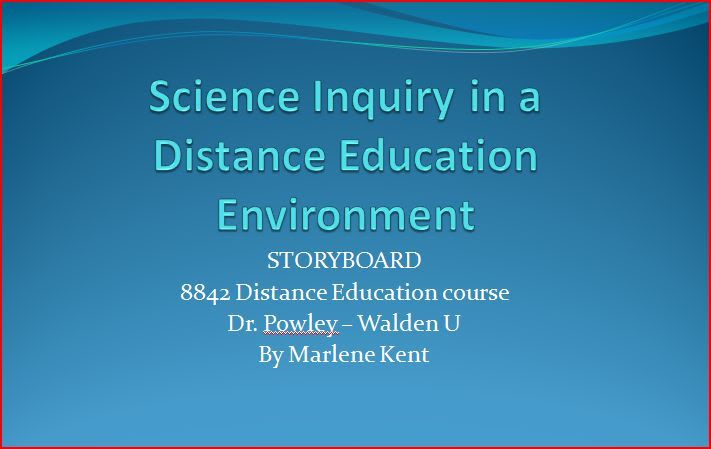
Slide 1)
http://i682.photobucket.com/albums/vv184/MKent48/Slide1A.jpg
Title: Science Inquiry in a Distance Education Environment:
STORYBOARD
8842 Distance Education course
Dr. Powley – Walden U
By Marlene Kent
Slide 2) http://i682.photobucket.com/albums/vv184/MKent48/Slide2A.jpg
Title: Traditional f2f recipe Biology labs
Video clip reenactment of students bored, off task, off topic, uninterested, unmotivated in a f2f teacher-directed lab situation on “The Effect of Temperature on Goldfish Respiration Homeostasis”.
Slide 3) http://i682.photobucket.com/albums/vv184/MKent48/Slide3A.jpg
Title: Inquiry Biology Homeostasis lab
Video clip of students engaged in asking questions, working in teams and designing their own inquiry lab on testing the effect of temperature on homeostasis in Goldfish respiration and behavior.
Slide 4) http://i682.photobucket.com/albums/vv184/MKent48/Slide4A.jpg
Title: Brain Neuroscience – Dopamine opens the doors
Recipe Labs: stress, boredom, confusion, low motivation, and anxiety can interfere with learning. Sensory input is blocked from entering the cortical areas of memory storage that lie beyond the amygdala
Inquiry Labs: Frontal lobe involvement
Neuronal circuits going from the limbic system (emotional center) into the frontal lobe and other parts of the brain are rich in dopamine receptors that are activated by this dopamine release (Nader et al. 2002).
Many of the strategies teachers use to engage students in learning have been demonstrated to activate this dopamine release (Wunderlich et al. 2005)
Slide 5) http://i682.photobucket.com/albums/vv184/MKent48/Slide5A.jpg
Title: Brain Neuroscience –
What turns on dopamine?
"With students' brains turned to the ideal state of activation, the speed and efficiency of information flowing through the filter to the learning centers of the brain is optimal.“ Willis, J (2007)
motivation ,
student-centered,
choices,
inquiry-based learning activities
Slide 6) http://i682.photobucket.com/albums/vv184/MKent48/Slide6A.jpg
Title: Mind Map of the Workshop
Main Topics
What is Inquiry Science & why?
Brain research?
How construct DE environment for science inquiry
Multimedia tools
Synchronous tools
Asynchronous tools
Team responsibilities
Assessments in a DE environment
Slide 7) http://i682.photobucket.com/albums/vv184/MKent48/Slide7A.jpg
Title: INQUIRY SCIENCE From f2f to DE
List of media tools for collaboration:
Asynchronous:
Wiki
Blogs
Forums
Videos – Hippocampus, Gizmos
Virtual Manipulatives - Gizmos
Synchronous:
Skype
Video conference call/Breeze
Video clip showing screen shots or video clips of:
blogs,
wikis,
skype,
virtual labs (Gizmos) on Human Homeostasis,
AP Bio video clips from Hippocampus,
Tutorials
Slide 8) http://i682.photobucket.com/albums/vv184/MKent48/Slide8A.jpg
Title: DE Assessment Strategies
Peer evaluation
Instructor Rubrics
Instructor evaluation on participation
Instructor evaluation on individual growth (improvement)
Student self-reflections
Student self-evaluation
Slide 9)http://i682.photobucket.com/albums/vv184/MKent48/Slide9A.jpg
Title: Team Developed Rubrics
Team Norms
Team Charter development and agreement
List of assignments and individual responsibilities
Time line for time management
Monitor of team process
Pre-teach activities: ExD tutorial, Homeostasis tutorial
Role-play activity with virtual lab manipulative
Individual labs with pre-agreed on procedures, collect data, share & analyze with team
Team reflection
Self-reflections
Slide 10) http://i682.photobucket.com/albums/vv184/MKent48/Slide10A.jpg
References:
Facione, P.A. (1990). The California critical thinking skills test: college level technical report #1 – experimental validation and content validity. Santa Clara Univ, CA: The CA Academic Press, pp.1-14. ERIC Document ED 327-549.
Hurst, D. & Thomas, J. (2010). Developing team skills and accomplishing team projects online. In T. Anderson (Ed.), The theory and practice of online learning (pp441-472). Edmonton, AB: AU Press, Athabasca University.
Siemens, G. (2008). Assessment of Collaborative Learning. (Vodcast). Principles of Distance Education DVD produced by Laureate Education, Inc. Baltimore.
Siemens, G. (2008). Learning Communities. (Vodcast). Principles of Distance Education DVD produced by Laureate Education, Inc. Baltimore.
Smith, L. M., (2006). Effective science tools supporting best practice methodologies in distance education. Greenwich: Distance Learning (3) 4, pp. 47-57. Retrieved from http:/proquest.umi.com.ezp.waldenulibrary.org/pqdweb?index=3&s…on September 19, 2010.
Willis, J. (2007). Preserve the child in every learner. Kappa Delta Pi Record (44)1, pp. 33-37. Retrieved from http://www.inspiringteachers.com/classroom_resources/articles/curriculum_and_instruction/preserve_the_child.html
http://i682.photobucket.com/albums/vv184/MKent48/Slide1A.jpg
Title: Science Inquiry in a Distance Education Environment:
STORYBOARD
8842 Distance Education course
Dr. Powley – Walden U
By Marlene Kent
Slide 2) http://i682.photobucket.com/albums/vv184/MKent48/Slide2A.jpg
Title: Traditional f2f recipe Biology labs
Video clip reenactment of students bored, off task, off topic, uninterested, unmotivated in a f2f teacher-directed lab situation on “The Effect of Temperature on Goldfish Respiration Homeostasis”.
Slide 3) http://i682.photobucket.com/albums/vv184/MKent48/Slide3A.jpg
Title: Inquiry Biology Homeostasis lab
Video clip of students engaged in asking questions, working in teams and designing their own inquiry lab on testing the effect of temperature on homeostasis in Goldfish respiration and behavior.
Slide 4) http://i682.photobucket.com/albums/vv184/MKent48/Slide4A.jpg
Title: Brain Neuroscience – Dopamine opens the doors
Recipe Labs: stress, boredom, confusion, low motivation, and anxiety can interfere with learning. Sensory input is blocked from entering the cortical areas of memory storage that lie beyond the amygdala
Inquiry Labs: Frontal lobe involvement
Neuronal circuits going from the limbic system (emotional center) into the frontal lobe and other parts of the brain are rich in dopamine receptors that are activated by this dopamine release (Nader et al. 2002).
Many of the strategies teachers use to engage students in learning have been demonstrated to activate this dopamine release (Wunderlich et al. 2005)
Slide 5) http://i682.photobucket.com/albums/vv184/MKent48/Slide5A.jpg
Title: Brain Neuroscience –
What turns on dopamine?
"With students' brains turned to the ideal state of activation, the speed and efficiency of information flowing through the filter to the learning centers of the brain is optimal.“ Willis, J (2007)
motivation ,
student-centered,
choices,
inquiry-based learning activities
Slide 6) http://i682.photobucket.com/albums/vv184/MKent48/Slide6A.jpg
Title: Mind Map of the Workshop
Main Topics
What is Inquiry Science & why?
Brain research?
How construct DE environment for science inquiry
Multimedia tools
Synchronous tools
Asynchronous tools
Team responsibilities
Assessments in a DE environment
Slide 7) http://i682.photobucket.com/albums/vv184/MKent48/Slide7A.jpg
Title: INQUIRY SCIENCE From f2f to DE
List of media tools for collaboration:
Asynchronous:
Wiki
Blogs
Forums
Videos – Hippocampus, Gizmos
Virtual Manipulatives - Gizmos
Synchronous:
Skype
Video conference call/Breeze
Video clip showing screen shots or video clips of:
blogs,
wikis,
skype,
virtual labs (Gizmos) on Human Homeostasis,
AP Bio video clips from Hippocampus,
Tutorials
Slide 8) http://i682.photobucket.com/albums/vv184/MKent48/Slide8A.jpg
Title: DE Assessment Strategies
Peer evaluation
Instructor Rubrics
Instructor evaluation on participation
Instructor evaluation on individual growth (improvement)
Student self-reflections
Student self-evaluation
Slide 9)http://i682.photobucket.com/albums/vv184/MKent48/Slide9A.jpg
Title: Team Developed Rubrics
Team Norms
Team Charter development and agreement
List of assignments and individual responsibilities
Time line for time management
Monitor of team process
Pre-teach activities: ExD tutorial, Homeostasis tutorial
Role-play activity with virtual lab manipulative
Individual labs with pre-agreed on procedures, collect data, share & analyze with team
Team reflection
Self-reflections
Slide 10) http://i682.photobucket.com/albums/vv184/MKent48/Slide10A.jpg
References:
Facione, P.A. (1990). The California critical thinking skills test: college level technical report #1 – experimental validation and content validity. Santa Clara Univ, CA: The CA Academic Press, pp.1-14. ERIC Document ED 327-549.
Hurst, D. & Thomas, J. (2010). Developing team skills and accomplishing team projects online. In T. Anderson (Ed.), The theory and practice of online learning (pp441-472). Edmonton, AB: AU Press, Athabasca University.
Siemens, G. (2008). Assessment of Collaborative Learning. (Vodcast). Principles of Distance Education DVD produced by Laureate Education, Inc. Baltimore.
Siemens, G. (2008). Learning Communities. (Vodcast). Principles of Distance Education DVD produced by Laureate Education, Inc. Baltimore.
Smith, L. M., (2006). Effective science tools supporting best practice methodologies in distance education. Greenwich: Distance Learning (3) 4, pp. 47-57. Retrieved from http:/proquest.umi.com.ezp.waldenulibrary.org/pqdweb?index=3&s…on September 19, 2010.
Willis, J. (2007). Preserve the child in every learner. Kappa Delta Pi Record (44)1, pp. 33-37. Retrieved from http://www.inspiringteachers.com/classroom_resources/articles/curriculum_and_instruction/preserve_the_child.html
Tuesday, September 28, 2010
DIFFUSION OF ONLINE COLLABORATION
WEB 2.0 & COLLABORATION
George Siemens is my hero when it comes to collaborative interactions and future trends for DE (Distance Education). I was first introduced to George Siemens’ alternative new learning theory “connectivism. ” (Siemens, 2010). George Siemens recognizes the changing personal learning environment and its advantages to the education process. Web 2.0 offers many interactive and collaborative opportunities for the business, education, and research communities on a global scale.
WHAT IS LEARNING?
I especially agree with Siemens’ vision of learning and the responsibility of the learner. From his conference presentation on "The Art of Blogging" (2004), George Siemens writes: … “learning is not simply a content consumption process.” Learning is also a content creation process. This can’t happen if the flow of knowledge is one way. Effective learning does not mean I absorb content, effective learning means I create content with my classmates and instructors, it’s not exclusively ‘me’ consuming.”
EVOLUTION OF SOCIAL NETWORKING
Social networking (PLNs Personal Learning Networks and PLEs Personal Learning Environments) are evolving quickly, starting in the early 2000’s (although some precursors actually started in the 90’s) with Wikipedia in 2001, MySpace, blogging, and Facebook in 2004 (which now has 500 million followers and brought in $800million in revenues last year). (Wikipedia, n.d.). More recently, Twitter has been the site of choice for following several conversations and interacting globally with colleagues. (Hopkins, 2010).
ADVANTAGES OF COLLABORATION
As technology improves and people experience interactions using web tools, the comfort gap is narrowed according to George Siemens (2008) and collaboration becomes a way of life. Some of the advantages include:
1) conversations are going outside to not-so-like-minded, global, diverse, international and corporate;
2) interactions can provide students with real life experiences in the Triple helix model with interactions between government, universities, and businesses;
3) and asynchronous collaboration in forums gives each student time to think, contemplate, research, and respond or pose higher level questioning – much better than being left behind in a f2f classroom; and
4) constraints for time and geography are not an issue with DE.
OPPOSITION TO COLLABORATION
There are some reports contrary to George Siemens’ that are opposed to collaborative learning strategies. Mr Sheey's blog (2007) on a case for collaborative learning in distance education did an analysis of negative comments from students and educators. Here is a summary of his findings:
1) mandatory interaction can be detrimental to learning and the need for interaction in DE is for voluntary conferring;
2) some distance learners are self-directed and resistant to team projects;
3) it takes more effort to maintain a community group and according to Brewer & Klien (2006) methods of small group collaboration have not proved to increase student achievement. I am not sure what measurement they used to come to this conclusion. Some measurement was from opinion surveys.
4) A pilot study was referenced that showed students agreed with the idea of collaboration, but 59% responded negatively in an opinion survey and the authors concluded that collaboration was a poor substitute for f2f communication.(McMurray et al, 1999). High trust and support is needed to be successful. I reviewed the course design and data collection in the McMurray report and concluded that this was an early study where the instructional design was mainly modeled after f2f classrooms, with the exception of discussion forums. There did not seem to be any attempt for learning collaboration. In addition, assessments were summative in the form of quizzes and tests, similar to an f2f classroom.
PERSONAL COLLABORATION EXPERIENCES
I have had limited experience through Walden in interactive projects and collaboration. I agree with the assigned community interactions being artificial. The concept of artificial vs natural conversation styles of blogging are discussed in a Distance Education course by an instructor (who does not post his name or the university), (2009, March 12). The author discusses the need to move away from an artificial style of discussions to a more natural style of conversation.
Also, I worked two wiki collaborations in Walden courses and they were little more than a place to post information, but not very interactive. According to Stephen Downes (2005), online learning is not merely for communicating information but to create a network and offer students the opportunity to push to higher order thinking. He would refer to my experience as cooperation but not collaboration. He also suggests the teacher participate and model collaboration activities and discussions.
I have not stretched myself yet to develop a PLN in my field and I am sure that will substantially increase my interactions and collaboration opportunities. The web tools to date are abundant. Some include: wikis, blogs, skype, breeze & eliminate, emails, Greplin (searches gmail, twiter, facebook, dropbox), and Google priority inbox.
AN ONLINE OPEN COURSE & COLLABORATION – INTRO TO PLNS & WEBTOOLS
George Siemens offers an online, open course called PLENK2010 (personal learning environments, networks, and knowledge). The following recommended PLN webtools are from Skipvia,(2010). In establishing your PLN, Skipvia recommends two reasons to create your own PLN: to build your own support system with 1) accessibility to colleagues and mentors and 2) responsibility to provide our own professional development, and offer help and answer questions of others.
What does a PLN look like?
1) for quick learning - Atomic learning, Wikipedia, youtube
2) for keeping up with your field - Diigo (social bookmarking tool and aggregate videos & text, research),blogs, news services, google reader, & instapaper
3) to publish & share tools – diigo, PBworks, flicker, youtube
4) for communication: email, skype & google wave (in depth communication with colleagues)
5) for collaboration: wikis, blogs, twitter (breadth and several conversations), LinkedIn & facebook (for depth), and
6) to find a way to follow several webtools by aggregating resources
An example of corporate collaboration can be found in a Cisco blog, where Cisco corporate is providing a new global interactive environment for its engineers and researchers with 30 embedded flash videos.(Schrotzberger, 2010).
SUMMARY
I agree with collaboration as a learning strategy and encourage it as much as possible in f2f classrooms. The inquiry-based processing should lead to higher level critical thinking skills practice if done correctly. The potential is already available for online global collaborative projects. The challenge is for each person to develop their own PLN in their field, for instructors to encourage their students to experience and practice using these tools in the learning process, and for organizations to take advantage of tapping into their global personnel for collaboration. Where there is opposition, there may be a deficit in trust, support, instructor modeling, or an artificial environment that needs to be more real.
Collaboration is a very different learning process and puts the center of learning on the learner, by requiring responsibility and accessibility on the shoulders of the learner, not the instructor.
References:
Distance Education course instructor blog (instructor unknown, 2009, March 12). Exploring theories, practice, and principles: Student collaboration in distance education. Retrieved from http://distanceed.byuipt.net/?get-id=354.
Downes. (2005, July 6). Are the basics of instructional design changing? Retrieved from http://www.elearnspace.org/blog/2005/07/06/are-the-basics-of-instructional-design-changing/.
Hopkins. (2010, May 12). Dont waste your time: Twitter in education. Retrieved from http://www.dontwasteyourtime.co.uk/presentations/presentation-twitter-in-education/..
McMurray, D. W. & Dunlop, M. E. (2009). The collaborative aspects of online learning: a pilot study. Retrieved from http://ultibase.rmit.edu.au/Articles/online/mcmurray1.pdf.
Schrotzberger. (2010, July 21). Experience what collaboration is doing for Cisco. Retrieved from http://blogs.cisco.com/collaboration/comments/experience_what_collaboration_is_doing_for_cisco/#more.
Sheehy. (2007, April 2). A teacher writes: Collaboration at a distance: A case for collaborative learning in distance education. Retrieved from http://ateacherswrites.wordpress.com/2007/04/02/collaboration-at-a-distance-a-case-for-collaborative-learning-in-distance-education/.
Siemens. (2004, June 7). The art of blogging. Retrieved from http://www.madlat.ca/presentations/Making%20IT%20Click/summaries/session10Siemens.pdf.
Siemens, G. (2008). The future of distance education. (Vodcast). Principles of Distance Education DVD produced by Laureate Education, Inc. Baltimore.
Siemens. (2010, Feb 16). Teaching in social and technological networks - connectivism. Retrieved from http://www.connectivism.ca/?p=220.
Skipvia. (2010, June 10). Personal learning networks for educators (video file). Retrieved from
http://www.youtube.com/user/skipvia#p/a/u/1/q6WVEFE-oZA.
Social networking websites. (n.d.). In Wikipedia. Retrieved from http://en.wikipedia.org/wiki/List_of_social_networking_websites.
George Siemens is my hero when it comes to collaborative interactions and future trends for DE (Distance Education). I was first introduced to George Siemens’ alternative new learning theory “connectivism. ” (Siemens, 2010). George Siemens recognizes the changing personal learning environment and its advantages to the education process. Web 2.0 offers many interactive and collaborative opportunities for the business, education, and research communities on a global scale.
WHAT IS LEARNING?
I especially agree with Siemens’ vision of learning and the responsibility of the learner. From his conference presentation on "The Art of Blogging" (2004), George Siemens writes: … “learning is not simply a content consumption process.” Learning is also a content creation process. This can’t happen if the flow of knowledge is one way. Effective learning does not mean I absorb content, effective learning means I create content with my classmates and instructors, it’s not exclusively ‘me’ consuming.”
EVOLUTION OF SOCIAL NETWORKING
Social networking (PLNs Personal Learning Networks and PLEs Personal Learning Environments) are evolving quickly, starting in the early 2000’s (although some precursors actually started in the 90’s) with Wikipedia in 2001, MySpace, blogging, and Facebook in 2004 (which now has 500 million followers and brought in $800million in revenues last year). (Wikipedia, n.d.). More recently, Twitter has been the site of choice for following several conversations and interacting globally with colleagues. (Hopkins, 2010).
ADVANTAGES OF COLLABORATION
As technology improves and people experience interactions using web tools, the comfort gap is narrowed according to George Siemens (2008) and collaboration becomes a way of life. Some of the advantages include:
1) conversations are going outside to not-so-like-minded, global, diverse, international and corporate;
2) interactions can provide students with real life experiences in the Triple helix model with interactions between government, universities, and businesses;
3) and asynchronous collaboration in forums gives each student time to think, contemplate, research, and respond or pose higher level questioning – much better than being left behind in a f2f classroom; and
4) constraints for time and geography are not an issue with DE.
OPPOSITION TO COLLABORATION
There are some reports contrary to George Siemens’ that are opposed to collaborative learning strategies. Mr Sheey's blog (2007) on a case for collaborative learning in distance education did an analysis of negative comments from students and educators. Here is a summary of his findings:
1) mandatory interaction can be detrimental to learning and the need for interaction in DE is for voluntary conferring;
2) some distance learners are self-directed and resistant to team projects;
3) it takes more effort to maintain a community group and according to Brewer & Klien (2006) methods of small group collaboration have not proved to increase student achievement. I am not sure what measurement they used to come to this conclusion. Some measurement was from opinion surveys.
4) A pilot study was referenced that showed students agreed with the idea of collaboration, but 59% responded negatively in an opinion survey and the authors concluded that collaboration was a poor substitute for f2f communication.(McMurray et al, 1999). High trust and support is needed to be successful. I reviewed the course design and data collection in the McMurray report and concluded that this was an early study where the instructional design was mainly modeled after f2f classrooms, with the exception of discussion forums. There did not seem to be any attempt for learning collaboration. In addition, assessments were summative in the form of quizzes and tests, similar to an f2f classroom.
PERSONAL COLLABORATION EXPERIENCES
I have had limited experience through Walden in interactive projects and collaboration. I agree with the assigned community interactions being artificial. The concept of artificial vs natural conversation styles of blogging are discussed in a Distance Education course by an instructor (who does not post his name or the university), (2009, March 12). The author discusses the need to move away from an artificial style of discussions to a more natural style of conversation.
Also, I worked two wiki collaborations in Walden courses and they were little more than a place to post information, but not very interactive. According to Stephen Downes (2005), online learning is not merely for communicating information but to create a network and offer students the opportunity to push to higher order thinking. He would refer to my experience as cooperation but not collaboration. He also suggests the teacher participate and model collaboration activities and discussions.
I have not stretched myself yet to develop a PLN in my field and I am sure that will substantially increase my interactions and collaboration opportunities. The web tools to date are abundant. Some include: wikis, blogs, skype, breeze & eliminate, emails, Greplin (searches gmail, twiter, facebook, dropbox), and Google priority inbox.
AN ONLINE OPEN COURSE & COLLABORATION – INTRO TO PLNS & WEBTOOLS
George Siemens offers an online, open course called PLENK2010 (personal learning environments, networks, and knowledge). The following recommended PLN webtools are from Skipvia,(2010). In establishing your PLN, Skipvia recommends two reasons to create your own PLN: to build your own support system with 1) accessibility to colleagues and mentors and 2) responsibility to provide our own professional development, and offer help and answer questions of others.
What does a PLN look like?
1) for quick learning - Atomic learning, Wikipedia, youtube
2) for keeping up with your field - Diigo (social bookmarking tool and aggregate videos & text, research),blogs, news services, google reader, & instapaper
3) to publish & share tools – diigo, PBworks, flicker, youtube
4) for communication: email, skype & google wave (in depth communication with colleagues)
5) for collaboration: wikis, blogs, twitter (breadth and several conversations), LinkedIn & facebook (for depth), and
6) to find a way to follow several webtools by aggregating resources
An example of corporate collaboration can be found in a Cisco blog, where Cisco corporate is providing a new global interactive environment for its engineers and researchers with 30 embedded flash videos.(Schrotzberger, 2010).
SUMMARY
I agree with collaboration as a learning strategy and encourage it as much as possible in f2f classrooms. The inquiry-based processing should lead to higher level critical thinking skills practice if done correctly. The potential is already available for online global collaborative projects. The challenge is for each person to develop their own PLN in their field, for instructors to encourage their students to experience and practice using these tools in the learning process, and for organizations to take advantage of tapping into their global personnel for collaboration. Where there is opposition, there may be a deficit in trust, support, instructor modeling, or an artificial environment that needs to be more real.
Collaboration is a very different learning process and puts the center of learning on the learner, by requiring responsibility and accessibility on the shoulders of the learner, not the instructor.
References:
Distance Education course instructor blog (instructor unknown, 2009, March 12). Exploring theories, practice, and principles: Student collaboration in distance education. Retrieved from http://distanceed.byuipt.net/?get-id=354.
Downes. (2005, July 6). Are the basics of instructional design changing? Retrieved from http://www.elearnspace.org/blog/2005/07/06/are-the-basics-of-instructional-design-changing/.
Hopkins. (2010, May 12). Dont waste your time: Twitter in education. Retrieved from http://www.dontwasteyourtime.co.uk/presentations/presentation-twitter-in-education/..
McMurray, D. W. & Dunlop, M. E. (2009). The collaborative aspects of online learning: a pilot study. Retrieved from http://ultibase.rmit.edu.au/Articles/online/mcmurray1.pdf.
Schrotzberger. (2010, July 21). Experience what collaboration is doing for Cisco. Retrieved from http://blogs.cisco.com/collaboration/comments/experience_what_collaboration_is_doing_for_cisco/#more.
Sheehy. (2007, April 2). A teacher writes: Collaboration at a distance: A case for collaborative learning in distance education. Retrieved from http://ateacherswrites.wordpress.com/2007/04/02/collaboration-at-a-distance-a-case-for-collaborative-learning-in-distance-education/.
Siemens. (2004, June 7). The art of blogging. Retrieved from http://www.madlat.ca/presentations/Making%20IT%20Click/summaries/session10Siemens.pdf.
Siemens, G. (2008). The future of distance education. (Vodcast). Principles of Distance Education DVD produced by Laureate Education, Inc. Baltimore.
Siemens. (2010, Feb 16). Teaching in social and technological networks - connectivism. Retrieved from http://www.connectivism.ca/?p=220.
Skipvia. (2010, June 10). Personal learning networks for educators (video file). Retrieved from
http://www.youtube.com/user/skipvia#p/a/u/1/q6WVEFE-oZA.
Social networking websites. (n.d.). In Wikipedia. Retrieved from http://en.wikipedia.org/wiki/List_of_social_networking_websites.
Subscribe to:
Posts (Atom)